Most property owners call for help when something already feels wrong. The air quality drops, energy bills go up, or the HVAC system starts working harder than it should. Then comes the question nobody gives a clear answer to: do you need air duct cleaning, duct sealing, or duct replacement? These are three different services, and picking the wrong one costs time and money.
What to Choose? One Wrong Decision Costs Buildings Thousands
Duct-related problems in commercial buildings and residential properties rarely come with a clear label. A facility manager in an office building may call for air duct cleaning when the problem is air leaking through gaps in the ductwork. A homeowner may pay for duct replacement when a thorough cleaning and seal would have solved the problem at a fraction of the cost.
Duct leakage in commercial and residential buildings accounts for up to 30% of heating and cooling energy loss. For a commercial building running HVAC systems across multiple floors, that percentage becomes thousands of dollars in wasted energy every year.
The starting point for any duct-related decision is understanding what each service does, what problems it solves, and when it applies.
What Is Air Duct Cleaning and When Do You Need It
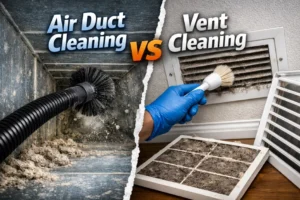
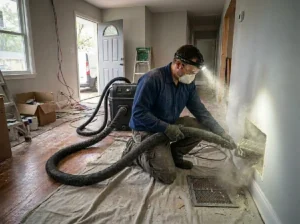
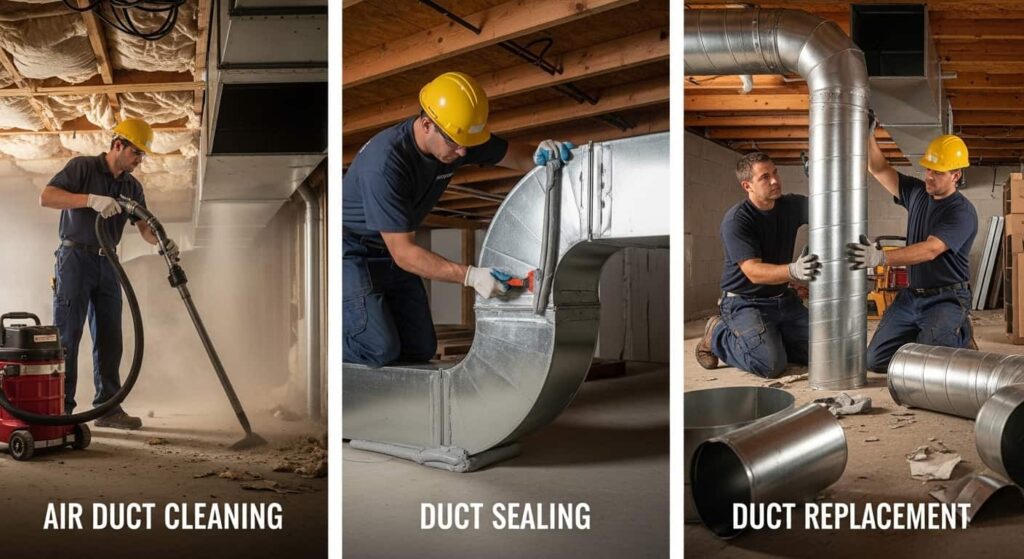
Air duct cleaning is the process of removing dust, debris, mold, allergens, and other contaminants that build up inside the ductwork over time. The process covers supply ducts, return ducts, grilles, diffusers, coils, drain pans, and the air handler unit.
Signs You Need Air Duct Cleaning
- Dust buildup around vents and grilles that comes back within days of wiping
- Staff or occupants in a commercial building reporting respiratory issues, headaches, or allergies
- A visible layer of debris when you remove a vent cover and look inside
- Mold growth is visible near the supply registers.
- The building went through a renovation, and the ductwork was not covered during construction.
- The HVAC system has not been serviced or cleaned in three years or more.
Air duct cleaning addresses the interior contamination inside a structurally sound duct system. It does not fix physical damage, and it does not stop air from leaking out through gaps or cracks. If the ducts are in good structural condition and the problem is contamination, cleaning is the right call.
Air Duct Cleaning Requirements for Commercial and Residential Properties
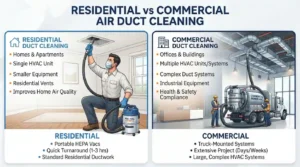
For commercial properties, air duct cleaning matters on a different scale. A hotel, office tower, school, or medical facility runs HVAC systems continuously. Contaminants accumulate faster and affect more people. The NADCA standard for commercial air duct cleaning recommends inspection and cleaning based on usage, occupancy type, and environmental conditions rather than a fixed schedule.
For residential properties, the EPA recommends air duct cleaning when there is visible mold growth, vermin infestation, or ducts clogged with debris to a level that restricts airflow.
What Is Duct Sealing and When Do You Need It
Duct sealing is the process of closing gaps, cracks, and loose joints in the ductwork that allow conditioned air to escape before it reaches its destination. The most common sealing methods involve mastic sealant, metal tape, or aerosol-based sealing products like Aeroseal that reach gaps from the inside of the duct system.
The structure of the duct is intact with this problem. Air is not blocked by contamination. It is physically escaping through openings that were either there from installation or developed over time as materials expanded and contracted with temperature changes.
Signs You Need Duct Sealing
- Energy bills increase without any change in usage patterns.
- Some rooms or zones in a commercial building receive less airflow than others.
- The HVAC system runs longer cycles to reach the set temperature.
- There is excessive dust in spaces that should be well-ventilated
- A pressure test or inspection reveals airflow loss between the air handler and the supply registers.
For commercial properties, duct leakage is one of the most expensive and least visible operational problems. A large office building or retail space with leaking ductwork pushes its HVAC system to compensate for the lost air constantly. The equipment runs more, wears faster, and consumes more energy every day the problem goes unaddressed.
Duct Sealing vs Air Duct Cleaning: The Difference
These two services are not interchangeable. Air duct cleaning removes what is inside the duct. Duct sealing closes physical openings in the duct wall. In many cases, a building needs both. The ducts may be contaminated and leaking at the same time. A professional inspection identifies which condition is present before any work begins.
What Is Duct Replacement and When Do You Need It
Duct replacement involves removing the existing duct system, or sections of it, and installing new ductwork. This is the most involved and most expensive of the three options. It applies when the duct system has damage or deterioration that cleaning and sealing cannot fix.
Conditions That Require Duct Replacement
- Ductwork that is more than 15 to 20 years old and shows physical deterioration throughout
- A flex duct that has collapsed, kinked, or torn in multiple locations
- Metal ductwork with corrosion, holes, or separations at multiple joints
- Duct systems with asbestos-containing materials that require abatement before any other work
- A building that is undergoing a full HVAC system upgrade, where the existing duct layout no longer fits the new system design
- Repeated mold growth inside ducts that comes back after cleaning due to moisture problems within the duct walls themselves
Duct replacement is not the starting point. It is the option when the duct system cannot perform its function, regardless of how well it is cleaned or sealed. Recommending replacement when cleaning or sealing would suffice adds unnecessary cost to the project. The correct approach is inspection first, then the appropriate service based on what the inspection reveals.
How to Decide: A Practical Breakdown
The three services address three different conditions. The decision comes down to what the inspection finds.
| Condition | Correct Service |
| Contamination, dust, mold, debris inside ducts | Air duct cleaning |
| Air leaking through gaps, high energy loss | Duct sealing |
| Physical damage, old deteriorated ducts | Duct replacement |
| Contamination and leakage both present | Air duct cleaning + duct sealing |
| Severe damage with contamination | Duct replacement + post-install cleaning |
For commercial buildings, the decision also involves compliance with air quality standards and HVAC performance targets. A facility that falls below acceptable air quality levels for employees or occupants faces liability and operational risk beyond just the energy cost.
The Cost of Delaying Any of These Services
This is the part most property owners and facility managers find out too late.
For Commercial Properties
A commercial building running with contaminated or leaking ductwork pays for the problem every month without knowing it. The HVAC system works against resistance. Equipment cycles more, energy consumption rises, and maintenance calls increase. Staff productivity in office environments with poor air quality drops. Hospitality properties face guest complaints. Healthcare facilities face compliance exposure.
None of these consequences comes from a single event. They build up over months and years in a duct system that was not given the right service at the right time.
For Residential Properties
For a home, the consequences show up in energy bills, in the health of the people living there, and in the lifespan of the HVAC system. A system running against dirty or leaking ducts wears its components faster. The repair cost down the line often exceeds what the cleaning or sealing would have cost years earlier.
What a Professional Inspection Covers
Before any of these three services begins, an inspection of the duct system gives a picture of what is actually happening. A professional inspection for air duct cleaning, duct sealing, or duct replacement typically includes:
- Visual inspection of accessible duct sections and all registers
- Camera inspection of duct interiors where direct access is limited
- Pressure testing to measure airflow loss and identify leakage points
- Identification of mold, moisture, or biological growth
- Assessment of duct age, material condition, and structural integrity
This step is what separates the right recommendation from a guess. Skipping the inspection and going straight to a service creates the risk of paying for something that does not solve the actual problem.
What Happens When You Mix Up the Three
Cleaning ducts that are leaking removes the contamination but leaves the energy loss in place. The system still runs inefficiently, and the problem returns. Sealing ducts that are heavily contaminated locks the contaminants inside and may make air quality worse. Replacing ducts that only needed cleaning and sealing adds thousands of dollars in unnecessary cost to the project.
The right service for the right condition is what produces a result that holds. That requires an honest assessment of what the duct system is doing and what it needs.
Work With a Team That Inspects Before They Recommend
At Alpha Clean Air, we work with commercial property managers, building owners, and residential clients across New Jersey, New York, Pennsylvania, and Connecticut. Our process starts with an inspection, not a sales pitch. Whether a building needs commercial air duct cleaning, duct sealing, duct replacement, or a combination of services, the recommendation follows what the inspection actually shows.
If your building has rising energy costs, air quality complaints, or a duct system that has not been looked at in years, the cost of waiting grows with every billing cycle. Contact us to schedule an inspection and get a clear answer on what your duct system actually needs.