Most homeowners rarely think about what’s happening inside their walls and ceilings — until a musty smell drifts from the vents, or someone in the household starts sneezing every time the furnace kicks on. Your HVAC system is one of the hardest-working parts of your home, and the ductwork that carries conditioned air from room to room is also a prime collector of dust, debris, mold, and contaminants that most people never see. This guide covers everything you need to know about air ductwork cleaning: when it matters, what professional air duct cleaning services actually do, how much it costs, and how to make sure the job is done right.
What Is Air Duct Cleaning, and Why Does It Matter for Indoor Air Quality?
Air duct cleaning is the process of removing dust, debris, mold contamination, and other contaminants from the interior surfaces of your HVAC system — including the supply and return ducts, grilles, diffusers, heat exchangers, air ducts coils, drip pans, fan motors, fan housing, and air filters. When done thoroughly, it covers the entire heating and cooling system, not just the visible vent covers.
Your ductwork acts like the lungs of your home. Every time your air conditioning system or heating system cycles on, it draws air through return grills, conditions it, and pushes it back through the supply ducts into your living space. If the duct interiors are coated with years of accumulated dust, pet dander, pollen, or mold growth, that same air carries those particles right back into the rooms where your family breathes.
Indoor air quality matters more than most people realize. The U.S. Environmental Protection Agency notes that indoor air can be significantly more polluted than outdoor air in some conditions, particularly in tightly sealed modern homes. While research suggests that duct cleaning alone doesn’t automatically improve health outcomes for everyone, there are specific circumstances where cleaning air ducts makes a genuine, measurable difference.
The important caveat: Routine duct cleaning is not universally necessary for every home every year. Normal household dust that settles in ducts — without moisture, pests, or excessive debris — generally stays put and does not get re-released into living areas. However, when real contamination exists, professional cleaning is not optional. It’s a health and safety matter.
Signs You Need Professional Air Duct Cleaning Services
Knowing when to call duct cleaners is just as important as knowing what they do. Here are the clearest red flags:
Substantial Visible Mold Growth
If you can see substantial visible mold growth on hard-surface ducts, on other components of your HVAC system, or around the vent covers and air vents in your home, that is one of the strongest reasons to pursue professional air duct cleaning immediately. Mold contamination spreads through air movement, which means your entire system can become a distribution network for mold spores if the problem isn’t addressed at its source. Note that mold identification isn’t always straightforward — some substances that look like mold may not be, and a professional inspection is the only reliable way to confirm.
Pest or Vermin Infestation Inside Ductwork
Rodents and insects inside ductwork leave behind droppings, nesting materials, debris, and biological contaminants that present real health risks. If you’ve noticed evidence of infestation — scratching sounds from within walls, droppings near floor vents, or visible pest activity — have both the pest problem and the resulting duct contamination addressed together, following guidance on signs of pest infestation in air ducts and removal.
Excessive Dust or Debris Released From Air Vents
If your vents or floor vents visibly release puffs of dust when your system turns on, or if you notice dramatic dust buildup on surfaces shortly after cleaning them, your ductwork may be contributing to the problem. Dirty duct interiors can act as a reservoir that the system continuously draws from.
Persistent Musty Odors or Unexplained Household Symptoms
A persistent musty or stale odor that intensifies when your heating or cooling system runs often points to mold growth or microbial contamination within the ductwork. Similarly, if household members experience allergy symptoms or respiratory irritation that improves when they’re away from home and returns when they come back, contaminated indoor air is worth investigating — and your duct work is a logical starting point.
After Water Damage, Renovations, or Rodent Activity
Water damage that reached your ductwork, including issues like condensation buildup or water dripping from air ducts, creates conditions ideal for mold growth even after visible water is gone. Construction dust from renovations — drywall particles, sawdust, and insulation fibers — can coat duct interiors in heavy layers. These are circumstances where professional cleaning is clearly warranted.
What Professional Air Duct Cleaning Services Should Include
Not all duct cleaning services are equal, and understanding how to choose the type of air duct cleaning that suits your needs — and what a legitimate job looks like — protects you from paying for something that doesn’t actually clean your system.
Full-System Cleaning: The Only Acceptable Standard
Reputable companies that provide duct cleaning services follow a whole-system approach. The National Air Duct Cleaners Association (NADCA) requires its certified members to clean the entire heating and cooling system — not just the accessible portions of the ductwork. This includes supply and return ducts, both the heating system and cooling system components, the air handler, blower motor, air ducts coils, drain pans, and all accessible components.
This matters because partial cleaning can cause recontamination. If technicians clean only the supply ducts while leaving contaminated return grills, air ducts coils, or fan housing untreated, the next time your system runs it will redistribute contamination right back through the freshly cleaned ducts. Source removal — meaning the physical removal of debris rather than just displacing it — is the accepted industry standard.
Documentation You Should Request
After any professional service, ask for written documentation of exactly what was cleaned, what methods were used, and what the technicians found. Before-and-after photographs or video inspection footage is the gold standard. If a company declines to provide visual evidence of their work, that’s a significant red flag.
How Technicians Break Contaminants Loose
Getting contaminants off duct interiors is a two-part process: agitation and collection. Professional cleaning relies on specialized equipment designed to dislodge even embedded contamination without damaging the ductwork.
Agitation Methods
The most common approach uses rotating brushes, air whips, or skipper balls — flexible tools connected to long rods that can travel deep into both metal ducts and flex ducts. These devices dislodge dust and debris from the duct walls, breaking contaminants loose so they can be collected by the vacuum system running simultaneously.
For more delicate flexible ductwork or complex configurations, hand-brushing and contact vacuuming may be used to dislodge dust without risk of puncturing the duct material. Some technicians combine multiple agitation methods depending on the duct material, level of soiling, and system layout.
Asking for Video Evidence
A trustworthy company should be willing to show you before-and-after camera footage from inside your ducts. Borescope or video inspection cameras allow technicians — and homeowners — to see actual duct interiors before cleaning begins and after the job is complete. If a company won’t show you what was in your ducts and what they removed, you have no way to verify that any cleaning actually occurred.
Collection of Contaminants and the Negative Pressure Method
Agitation alone isn’t enough. Breaking contaminants loose without capturing them immediately would simply release debris into your living space. This is why professional cleaning relies on continuous negative pressure — a powerful vacuum system that maintains suction throughout the entire cleaning process.
How Negative Pressure Works
Technicians connect a high-powered vacuum collection unit to the ductwork, creating negative pressure within the system. This negative pressure ensures that any dust, debris, or mold contamination dislodged by agitation tools is immediately drawn toward the vacuum rather than released into the home. The system acts essentially like a sealed vacuum bag around your entire duct network.
Truck-Mounted vs. Portable Vacuums
Two types of vacuum collection equipment are commonly used. Truck-mounted vacuums are large units in a service van connected to the home via long hoses; they offer extremely high suction power and are well-suited for larger systems with heavy contamination. Portable vacuums are brought directly into the home, offering flexibility in tight spaces or multi-story buildings where hose runs would be impractical. Both can perform well when properly sized for the job.
Verifying Containment
Before any agitation begins, ask how the technician will prevent dust from being released into your home. Proper containment means access holes are sealed, return grills are blocked off while cleaning supply lines (and vice versa), and the vacuum collection system is confirmed to be working before tools are run through the ducts. If a technician skips containment protocols, contamination can spread throughout your living space rather than being removed.
Access, Tools, and Equipment Requirements
Getting cleaning tools into ductwork requires proper access points — and understanding this process helps homeowners know what to expect during a service call.
Accessing the Ductwork
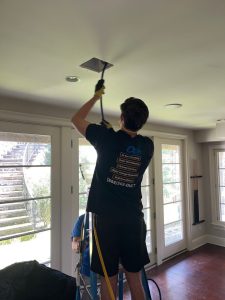
Technicians typically access ducts through the existing service openings: return grills, supply registers, floor vents, and the air handler access panels. In many homes, the existing openings are sufficient for thorough cleaning using flexible tool extensions.
When existing openings don’t provide adequate access to all sections of the duct system, technicians may need to cut small access holes in the duct walls. A reputable company will use sheet metal screws and industry-standard duct end caps or access panels to reseal these openings professionally after the job. Any cuts made in your ductwork should be sealed so well that no air leaks — a patched duct that leaks conditioned air into a wall cavity creates energy loss and potential moisture problems.
Video Inspection Equipment
Professional air duct cleaning should include video inspection both before and after the cleaning. Pre-cleaning inspection documents the condition of duct interiors and identifies any damage, mold contamination, pest evidence, or structural issues. Post-cleaning inspection verifies that the job was completed properly. Camera systems can reach far into the duct network through existing openings, providing visual documentation without unnecessary cutting.
Air Vents and Air Filter Checks
During a professional service, technicians should also inspect and clean the air vents and vent covers, check the condition of air filters, and note any visible issues with the broader HVAC system — including signs of leaking, damage, or areas that warrant follow-up attention.
Antimicrobial Chemicals and Sealants: Use with Caution
Chemical treatments are a point of legitimate controversy in the air duct cleaning industry. Used appropriately, EPA-registered antimicrobial products can reduce microbial contamination after mechanical cleaning. Used indiscriminately, they can introduce chemicals into your home’s air supply without any real benefit.
Only After Mechanical Cleaning
The EPA’s guidance is clear: chemical biocides should only be applied after the ductwork has been thoroughly cleaned by mechanical means. Applying chemicals to ducts coated in dust and debris is ineffective because the biocide simply sits on top of the contamination rather than reaching the surface. Source removal first — chemicals only if warranted afterward.
Verifying EPA Registration
Before allowing any chemical application in your ductwork, ask for the product name and confirm that it is registered with the EPA for use in HVAC systems. Legitimate products have registration numbers and are labeled for their specific application. Duct sealants, similarly, should be appropriate for use in occupied buildings and applied only in circumstances where they are genuinely needed — not as a default treatment.
Cost Factors for Cleaning Air Ducts
Understanding what drives pricing helps you evaluate quotes intelligently and avoid being misled by unusually low offers.
Typical Residential Price Ranges
For a standard single-family home, professional air duct cleaning typically runs between $300 and $700 for a basic system cleaning, with an average around $450–$500 for a typical home. Larger homes or heavily contaminated systems can push costs higher — sometimes well above $1,000.
Pricing by Square Footage and Vent Count
Most companies price either by square footage of the home, by the number of vents and returns in the system, or by a combination of both. A per-vent model typically runs $25–$50 per vent, while square footage pricing usually falls in the range of $0.15–$0.35 per square foot.
Flex Ducts vs. Metal Ducts
Cleaning flex ducts is often more labor-intensive than cleaning rigid metal ducts. Flexible duct material is more delicate and may require different agitation tools and more careful technique to avoid damage. Expect slightly higher costs for systems with extensive flexible ductwork.
Add-On Costs
Mold remediation, when confirmed contamination exists, adds significant cost beyond basic cleaning — often $500–$3,000 or more depending on the extent of the problem. Pest removal and associated cleanup, duct repairs, video inspection fees (sometimes included, sometimes extra), and application of antimicrobial chemicals or air duct sanitizing and disinfecting all represent potential additional line items. Always ask for a written estimate that itemizes these possibilities before authorizing work.
The Danger of Suspiciously Low Quotes
Bait pricing — ads offering whole-house duct cleaning for $49 or $99 — is one of the most persistent air duct cleaning scams you should know in the home services industry. Companies that advertise prices dramatically below market rates often plan to pressure homeowners into expensive add-ons after gaining access to the home, or they perform no meaningful cleaning at all. A legitimate professional job cannot be done for $49. Period.
How to Choose Air Duct Cleaners and Duct Cleaning Companies
Selecting the right company is as important as deciding to have the work done at all.
Require NADCA Certification or Equivalent Training
The gold standard credential in this industry is NADCA certification. NADCA (National Air Duct Cleaners Association) sets industry standards, requires members to have certified Air Systems Cleaning Specialists (ASCS) on staff, and mandates the whole-system cleaning approach. Asking whether a company has NADCA-certified technicians filters out most of the worst operators.
Request Written Estimates Detailing Scope and Exclusions
Before authorizing any work, get a written estimate that specifies exactly what will be cleaned, what is excluded, what equipment will be used, and how access will be handled. Verbal promises mean nothing if the company performs a different (and less thorough) service.
Check the Better Business Bureau and Consumer Reviews
Look up any company you’re considering with your local Better Business Bureau and read reviews from verified customers. Pay particular attention to complaints about bait pricing, incomplete work, or high-pressure upselling tactics. A company’s complaint history is often more informative than its average star rating.
Ask About Insurance and Liability Coverage
Duct cleaning requires technicians to access your HVAC equipment and make physical cuts in your ductwork in some cases. Before you proceed, it also helps to understand the pros and cons of duct cleaning for your specific situation. Confirm that the company carries general liability insurance and workers’ compensation coverage. If a technician damages your HVAC system or is injured on your property and the company is uninsured, you could be left with the liability.
Demand Before-and-After Visual Evidence
Reputable duct cleaners are proud to show their work. Insist on before-and-after photographs or video footage of the duct interiors. Companies unwilling to provide visual evidence of their cleaning either lack the inspection equipment to do the job properly or have something to hide.
Inquire About Chemical Use and Safety Data
If any company plans to apply chemicals to your ductwork, ask for the product names and safety data sheets before work begins. You have every right to know what substances are being introduced into your air supply.
DIY Cleaning of Air Vents: What Homeowners Can Safely Do
There are genuine maintenance tasks homeowners can handle themselves — and real limits to how far DIY should go.
What You Can Do Yourself
Vacuuming and wiping down vent covers and return grills is well within any homeowner’s ability. Remove the covers, wash them with mild soap and water, and vacuum the first few inches of the visible duct opening. This removes surface dust and keeps the visible portions of the system clean without requiring specialized equipment.
Replacing or checking air filters regularly is the single highest-impact maintenance task most homeowners neglect. A clogged filter restricts airflow, reduces system efficiency, and allows the debris that would have been captured to instead recirculate or accumulate on the air ducts coils and blower components. For most households, filter replacement every 1–3 months is appropriate.
When to Avoid DIY
If you suspect mold growth, pest infestation, or contamination beyond simple dust, stop at the vent covers and call a professional. Without proper vacuuming equipment, containment, and negative pressure, attempting DIY cleaning in a contaminated system is more likely to spread contaminants through your home than to remove them.
Preparing for a Professional Service Call
Clear the areas around floor vents and wall registers before technicians arrive. Move furniture away from supply and return air vents, ensure easy access to the air handler and furnace area, and remove any items stored in front of mechanical room access panels. This simple preparation reduces service time and ensures technicians can reach all necessary access points.
Preventing Recontamination and Improving Home Air Quality Long-Term
Professional cleaning treats the existing contamination. These steps help keep your system clean afterward.
Use a Higher-MERV Air Filter
Standard fiberglass filters (MERV 1–4) capture large particles but allow finer dust and allergens to pass through and accumulate in the system. Upgrading to a MERV 8–11 filter captures significantly more of the particles that would otherwise build up on duct interiors and air ducts coils. However, verify with your HVAC system documentation or a technician that your system can handle the reduced airflow of a higher-efficiency filter — some older systems can’t.
Seal Duct Leaks to Reduce Dust Entry
Leaky ductwork is one of the primary ways that dust, insulation particles, and other contaminants enter the duct system from wall cavities, attics, and crawl spaces. Sealing leaks with mastic sealant or professional duct sealing tape not only improves energy efficiency but also helps prevent dust from contaminating duct interiors between cleanings.
Control Indoor Humidity
Mold growth requires moisture. Maintaining indoor humidity between 30–50% deprives mold of the conditions it needs to grow in your ductwork and on the air ducts coils. Use bathroom and kitchen exhaust fans consistently, fix plumbing leaks promptly, and consider a whole-home dehumidifier if you live in a humid climate.
Schedule Regular HVAC Maintenance and Inspections
Annual professional HVAC maintenance — including checking the air ducts coils, blower, drain pans, and refrigerant levels — catches conditions that lead to contamination before they become serious problems. A well-maintained cooling system and heating system is far less likely to develop the moisture problems or airflow inefficiencies that allow contamination to build up, and it also helps prevent recurring dust and mold problems after air duct cleaning.
Consider an Air Purifier for Persistent Allergens
For households with pets, allergy sufferers, or anyone dealing with persistent indoor air quality concerns, a HEPA air purifier provides supplemental filtration beyond what the HVAC air filters can deliver. Purifiers don’t clean ductwork, but they do remove circulating particles from the living space — which can meaningfully improve comfort and air quality between HVAC maintenance cycles.
What to Expect During and After a Professional Service
Understanding the typical service experience reduces surprises and helps you evaluate whether the job was done properly.
Timeline and Disruption Levels
A thorough professional cleaning for a typical home takes 3–5 hours. Larger homes or systems with heavy contamination take longer. Expect noise — the vacuum collection equipment is loud, and agitation tools produce audible vibration in the ductwork. You’ll need to provide access to all areas of the home where vents are located and to the mechanical room or utility area where the air handler is installed.
In most cases, you can remain in the home during the cleaning, though it’s often more comfortable to be in rooms away from where the work is being done. The technicians should have shoe covers and take care to protect floor surfaces near access points.
Final Walkthrough and System Performance Check
Before the technicians leave, conduct a final walkthrough. Confirm that all vent covers and return grills have been replaced, all access holes have been properly sealed, and the system runs normally when cycled on. A responsible company will test the system before departing.
Obtain Written Proof of Services
Request written confirmation of exactly what was cleaned, what equipment was used, any findings noted during inspection (such as damage or evidence of past moisture intrusion), and any guarantees the company offers. This documentation matters if issues arise after the service.
Verify Results Using Video
The only way to truly confirm that your ducts are clean is to see the duct interiors after the job. Ask for post-cleaning video footage or photos. If the company lacks camera equipment to show you the results, they also lacked it to do the job thoroughly.
Common Misconceptions and Safety Considerations
Duct Cleaning Does Not Always Prevent Illnesses
Research suggests that duct cleaning improves conditions in specific cases of real contamination but doesn’t provide universal health benefits for homes without documented contamination problems. The EPA does not recommend routine duct cleaning as a general preventive health measure. If you’re pursuing cleaning, do so based on genuine need — not marketing claims.
Bait Pricing Masks Poor Work
Low-cost offers for “whole house” duct cleaning at dramatically discounted prices are almost universally a warning sign. These companies typically perform a superficial service, pressure homeowners into expensive chemical treatments or repairs, or both. The true cost of professional cleaning reflects real labor and equipment — shortcuts produce worse results than no cleaning at all.
Biocides Are Not a Substitute for Mechanical Cleaning
Some companies lead with chemical treatments rather than thorough mechanical cleaning. Only chemicals applied to dirty duct interiors don’t work. The EPA’s guidance is unambiguous: mechanical source removal comes first; chemical treatments are an optional, secondary step for documented microbial contamination only.
Fuel-Burning Appliances and Carbon Monoxide Safety
If your HVAC system includes a gas furnace, boiler, or other fuel-burning appliance, any service work involving the system is also an opportunity to verify the safety and integrity of those components. Ask whether the technicians will inspect the heat exchanger and confirm there’s no evidence of cracking or compromised combustion venting. Carbon monoxide (CO) leaks from cracked heat exchangers are a genuine safety risk, and the inspection during a duct cleaning service is a natural opportunity to catch early warning signs.
Checklist Before Hiring Duct Cleaners
Use this checklist before committing to any duct cleaning company:
- Ask for a detailed written scope of work before the service begins
- Confirm that technicians will clean all HVAC components, not just the accessible duct runs
- Verify NADCA certification or equivalent professional credentials
- Request references from recent local customers and actually contact them
- Confirm the company carries general liability and workers’ compensation insurance
- Inquire about state licensing requirements in your area (requirements vary by state) and verify compliance
- Ask what happens if access holes need to be cut — how will they be sealed?
- Clarify what chemicals, if any, will be used and request product names and safety data sheets
- Get a written estimate that itemizes all potential additional costs before authorizing the work
Quick FAQs and Decision Guide
Do I definitely need duct cleaning? Not necessarily. If your home has no history of flooding or water damage affecting the ductwork, no pest infestation, no visible mold, no unusual odors from the vents, and no recent major renovation, your ducts may be fine with regular filter changes, choosing the type of air duct cleaning that suits your needs when necessary, and annual HVAC maintenance. Homeowners in specific areas such as Brick, NJ may still benefit from periodic air duct cleaning services in Brick every few years, especially if they have pets or allergy sufferers in the household.
What if I see or smell mold coming from my vents? This is an urgent situation. Stop running the system if possible and contact a professional for inspection. Mold contamination in ductwork requires professional remediation — not a standard cleaning service.
What if I’m not sure whether I need cleaning? Contact a trusted HVAC professional — not a duct cleaning company with an incentive to recommend their own service — for an honest inspection and assessment. An HVAC technician without a financial stake in the cleaning decision will give you the most objective evaluation.
Should I get multiple quotes? Yes. Get at least three written quotes from NADCA-certified companies before committing. Compare scope, not just price — a lower quote that excludes key components is not a better deal.
How often should ducts be cleaned? NADCA suggests every 3–5 years as a general guideline for most homes, with more frequent cleaning warranted in homes with pets, allergy sufferers, or any of the specific contamination risk factors described above. If you live in the New York area, scheduling professional air duct cleaning in New York on this cadence can help maintain indoor air quality and system efficiency.
This guide is intended for educational purposes. Individual circumstances vary — when in doubt, consult a qualified HVAC professional for an inspection specific to your home and system.