There’s probably nothing more unsettling than realizing you’ve got a pest infestation in your air ducts.
Regardless of how you figured it out, you need to make sure you’re dealing with the aftermath the right way. What you need to know is that getting the pests removed is just the first step. Pests leave behind droppings and other hazardous byproducts that can pose serious health risks if you don’t act fast. Here’s everything you need to know about air duct cleaning after pest infestation.
How Do Pests Even End Up in Your Ductwork?
Knowing how pests end up in your ductwork in the first place is the first step to getting rid of them.
Rodents, such as mice, rats, and even squirrels, are remarkably resourceful at finding their way into homes. In fact, they can enter through gaps around any pipes or vents, through crawl spaces and attics, and even through cracks in your home’s foundation.
Once they’ve made way, it’s the perfect spot for them. It’s warm, dark, and protected from predators. Insects can take advantage of these entry points as well, and even birds. The unfortunate part about all this is that it’s a lot more common than most people realize.
What Pests Leave Behind
While you might think pests are gone and the problem’s over, that’s hardly the truth. What is left behind is probably the most concerning bit.
The first and most obvious answer is droppings and urine. Rodent droppings contain serious diseases such as hantavirus, leptospirosis, and Salmonella. Breathing airborne particles of these droppings can get you devastatingly ill.
The reason why this is a major concern is that every time your HVAC system runs, it creates airflow through the ducts. Any particles in the ducts, including dried fecal matter, can become airborne and circulate throughout your entire home.
Here’s what routinely flows through your airducts if you’ve got a pest infestation:
- Hair from rodents and other pests can worsen your allergies
- Nesting materials that block airflow and become fire hazards
- Small particles of dead rodents or birds
- Chewed up materials such as plastic ducts and wires
All of this adds up to a serious indoor air quality problem that doesn’t go away just because the pests are gone. The contamination remains in your ducts, circulating through your home every day.
What is DIY Cleaning Not the Answer?
Lots of homeowners are tempted to handle this on their own. If this were any other sort of air duct cleaning, we might even have endorsed the idea. But when it comes to a pest infestation, you can’t be taking chances.
Here’s why:
Health risks during cleaning
Moving around rodent droppings releases harmful particles into the air. Without proper protection and containment methods, you’re exposing yourself to exactly the pathogens you’re trying to get rid of.
Inadequate equipment
Your household vacuum simply isn’t designed for this job. It doesn’t have the filtration to trap the microscopic particles, so you’re likely just spreading contamination around. Professional duct cleaning uses vacuum systems with HEPA filtration that capture particles as small as 0.3 microns. Standard household equipment can’t match that.
You can’t clean and reach the entire system
Professional companies use long brushes and agitation tools that reach throughout the ductwork, along with extraction methods that pull out all these droppings and byproducts from every section of the system. From the inside of your house, you can only access the visible portions near vents and registers. The bulk of the contamination is deep in the system where you can’t reach it.
Proper sanitization requires professional products
After the mechanical cleaning, ducts need to be sanitized to kill bacteria and viruses. EPA-registered antimicrobial treatments used by professionals are safe when applied correctly. Using the wrong chemicals can create hazards or leave residue that contaminates indoor air.
You might end up causing more damage
Without knowing how duct systems are made and how to properly clean them, it’s easy to make things worse rather than better. These mistakes create new problems that cost more to fix than professional cleaning would have cost initially.
Also Read: Air Duct Cleaning vs Air Duct Sanitizing: What’s the Difference?
What’s Included in a Professional Air Duct Cleaning Process?
If you’re wondering what a professional cleaning session actually includes, here’s the gist of it:
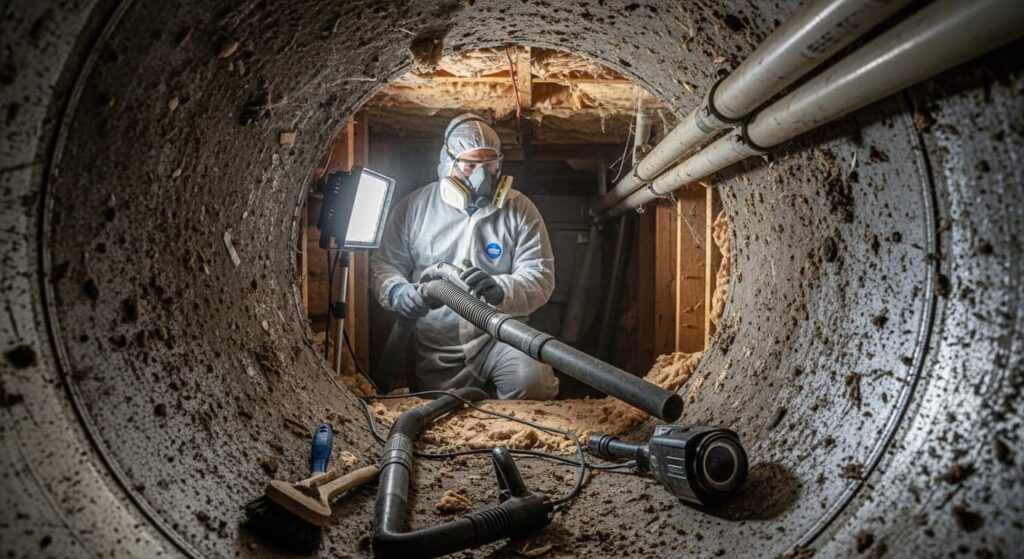
Initial inspection and assessment come first. We start with a thorough examination of your entire duct system, typically using cameras to inspect hard-to-see areas. We’re looking for the extent of the damage, the condition of the ductwork, and the entry points.
This inspection informs the cleaning plan and helps identify repairs needed to prevent reinfestation.
Next, system preparation involves sealing off your living spaces to prevent contamination from spreading during cleaning. This is usually done with the help of negative pressure in the duct system, meaning air flows into the ducts rather than pushing particles out into your home.
There are layers to the cleaning process. The first part is the mechanical part of it. This involves:
- Agitation with rotating brushes that dislodge dirt from the duct walls
- Powerful vacuum extraction
- Working systematically through the entire duct system
- Removal of all accessible nesting material, droppings, and debris
Professional equipment pulls contamination through the duct system and into a collection system outside your home. The particles don’t just get stirred up and resettled; they’re completely removed from the premises.
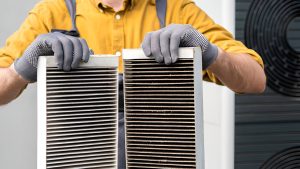
The second layer is the HVAC cleaning. Sure, ducts are important, but so is your HVAC! The cleaning should include:
- Blower motor
- Evaporator coil
- Air cabinet
- Heat exchanger furnace
Then comes the disinfection part. EPA-registered antimicrobial products designed specifically for HVAC systems are applied to duct surfaces. This kills bacteria and viruses that might remain after physical cleaning.
Once that’s done, it’s time for a proper seal and repair. If you miss this part, everything done above is practically useless. Any gaps, holes, or damaged sections identified during inspection should be repaired. This includes:
- Sealing disconnected duct sections
- Repairing holes chewed by rodents
- Replacing damaged insulation
- Installing or replacing vent screens and covers
- Sealing gaps around duct penetrations through walls and ceilings
Nothing is ever complete without a thorough and final inspection and testing. We typically provide our clients with before-and-after photos, test airflow, and confirm that all access panels and registers are properly reinstalled.
What Should You Expect During and After Cleaning?
During the process, you’ll hear quite a lot of noise from all the professional equipment being used. You might also notice some vibration in the ducts.
We will need access to all registers and returns throughout your home. We’ll be working in your attic, basement, or crawl space if that’s where ductwork is located. Plan for us to be moving through your house, and make sure these areas are accessible.
Once your ducts are cleaned, you’ll notice your home’s air is a lot fresher. If the HVAC was clogged because of nesting materials, you’ll see a drastic improvement in the airflow as well.
Can You Prevent Pest Infestations from Happening Again?
Yes, we thought you’d never ask!
Professional cleaning solves the immediate problem, but prevention keeps it from happening again. Vent covers should be intact since this is what primarily prevents pest access.
Seal potential entry points around your home. Common areas include:
- Around window and door frames
- Foundation cracks
- Gaps
- Around pipes through walls
- Gaps under doors
If you’ve let your garden grow loose, now is a good time to trim all the vegetation around your house. We say this because tree branches that touch your roof or walls are most likely the bridge for rodents to use to get there.
When is the Right Time to Call in the Pros?
It’s never too late to call in a professional if you’ve left the issue grow graver by the day. Yes, it may take them longer to clean your air ducts, but they’ll always do a great job.
Call for an immediate inspection the moment you think you’ve noticed:
- Squeaking sounds from ducts or walls
- Visible droppings
- Unusual smells
- Lots of insects around ducts and vents
- Recent pest activity in your attic, crawl space, or walls
You might think you’re perfectly capable of handling the situation on your own, but that’s just something you’re telling yourself to feel better. Professional cleaning is no match for a DIY-clean. You’ll probably use anything and everything you can get your hands on, but we use professional equipment and tools that were designed for this very issue.
Pest Infestation Be Gone!
Finding pests in your air ducts is never how anyone wants to spend their morning. But there’s no point in crying over spilled milk, is there?
The good news is that this problem is entirely fixable! The key to getting rid of pests is having it addressed by a professional. They’ll not only remove the pests, but also perform a thorough air duct cleaning that cleans up all the contamination left behind.
At Alpha Clean Air, we’ve seen it all, from minor problems to severe infestations. We understand the health implications, we have the equipment and expertise to remove all traces of contamination, and we take pride in restoring homes to healthy conditions. If you’re dealing with the aftermath of a pest infestation, we’ll help you solve it completely.