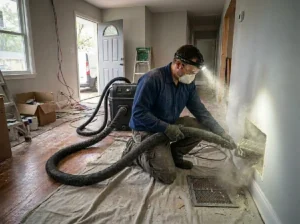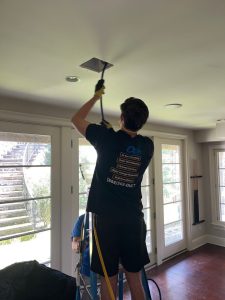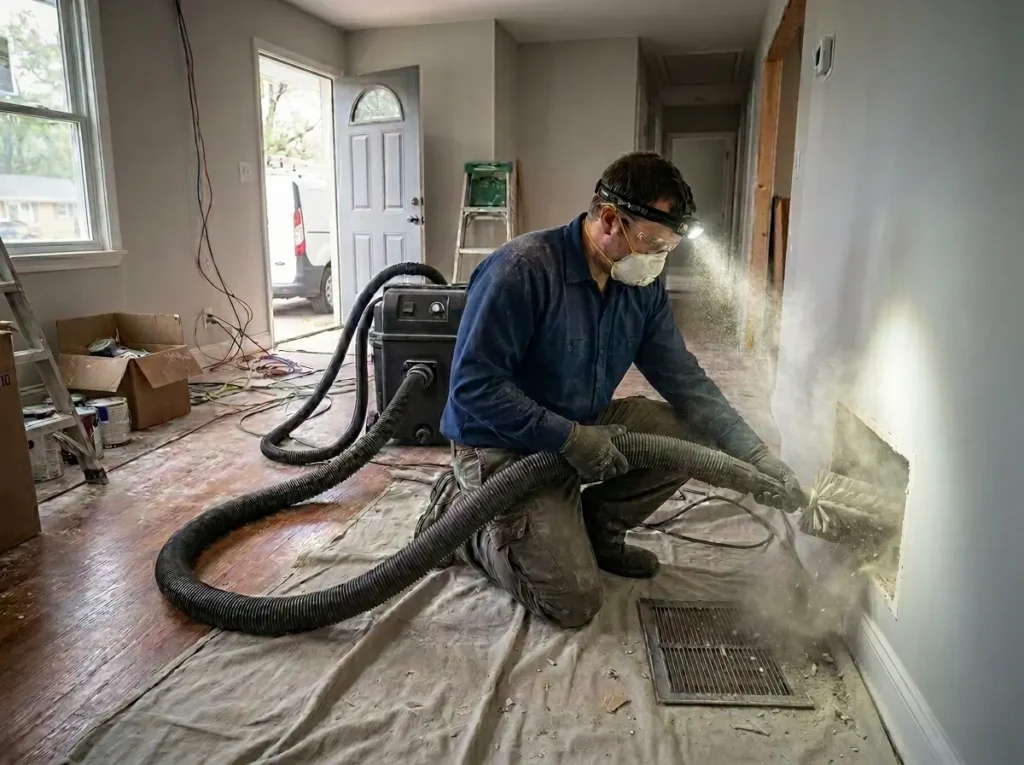
You just finished your renovation, and the space finally looks the way you always imagined it. What nobody tells you is that while the contractors were working, your ductwork was quietly collecting everything the renovation produced, drywall dust, silica particles, mold spores, VOCs from fresh paint and adhesives, and insulation fibers that standard HVAC filters were never designed to catch.
Unlike ordinary household dust, which is 90% biological and relatively harmless in small quantities, renovation dust is predominantly mineral based. Those particles are denser, finer, and far more persistent than anything your system handles on a normal day. The moment your HVAC kicks after a renovation, it pulls that contamination through supply lines and delivers it into every room in the building. That is exactly what post-renovation air duct cleaning in NJ is designed to stop. It helps protect your health, your HVAC system, and the air quality of everyone who lives or works inside the newly transformed space.
What Gets Into Your Ducts During a Renovation
During renovation, construction dust bypasses filters through return air pathways and gaps around registers. Once inside the duct system, every HVAC cycle distributes that contamination through the entire building. The EPA’s guidance on indoor air quality during remodeling specifically recommends sealing supply and return registers during renovation to prevent duct contamination. When that step gets skipped, post-renovation duct cleaning becomes the only way to address what entered the system.
| Contaminant | Source | Health Risk |
| Drywall dust | Wall cutting and sanding | Continuous airway irritation |
| Silica | Tile, masonry, concrete work | Irreversible lung damage |
| VOCs | Paints, adhesives, sealants | Off-gas for weeks to months |
| Mold spores | Demolition of moisture-damaged materials | Deep lung penetration |
| Insulation fibers | Cutting or disturbing insulation | Chronic lung tissue irritation |
| Lead paint dust | Pre-1978 NJ properties during demolition | No safe exposure level for children |
Did You Know?
Your HVAC recirculates indoor air 5 to 7 times per hour. After a renovation, every single cycle pushes contamination through supply lines, meaning renovation particles travel through your space dozens of times before most people realize the problem exists.
Read More: How to Choose a Reliable Air Duct Cleaning Company in New Jersey
Top Reasons You Must Schedule Post-Renovation Air Duct Cleaning in NJ
Most NJ homeowners and office managers treat post-renovation cleanup as a surface-level task. The real contamination sits inside your duct system, and it stays there until it is professionally removed. Here is exactly why that matters for your health, HVAC, and investment.
Reason 1: Your HVAC Becomes a Contamination Delivery System
Once renovation debris enters your duct system, the HVAC does not just fail to remove it. Every cycle actively spreads it further through the entire building, reaching rooms that were never touched by the renovation itself.
Why Standard Filters Cannot Stop It
- Residential and commercial filters are rated for normal airflow conditions, not renovation particle loads
- Renovation work produces concentrations far beyond what standard filter media was designed to handle
- The finest particles are also the smallest and most likely to slip through filter media entirely
- Once past the filter, those particles settle directly onto duct walls where no filter change can reach them
Where the Contamination Goes Every Time the System Runs
- Through supply registers into bedrooms, nurseries, living rooms, and kitchens in homes
- Across every floor sharing the same air handler in a commercial office building
- Into conference rooms, open-plan workspaces, and break rooms in renovated office environments
- Back through return vents, through the system again, and out through every supply point repeatedly
The contamination is not concentrated near the renovation area. It travels wherever the air goes and keeps traveling until the source inside the ducts is physically removed by a professional.
Pro Tip:
If your HVAC was running during any part of the renovation, even briefly, assume contamination entered into the system. Renovation particle loads are high enough that even a few hours of HVAC operation during construction distributes debris deep into the duct network.
Reason 2: The Health Risk Is Real for Both Homes and Offices
Suspended renovation dust contained more than one million fungal colony-forming units per gram. That level of contamination shows how quickly construction dust can affect the air moving through a building. Aspergillus and Penicillium species were among the most common, both capable of penetrating deeply into the lungs and triggering serious respiratory responses. Those concentrations settle into duct surfaces and release with every HVAC cycle until the system is professionally cleaned.
Who faces the greatest risk in NJ homes:
- Children, who breathe in more airborne dust than adults
- Older adults with heart or lung conditions
- People with allergies or asthma, who are more sensitive to dust and mold
- Pets, which spend more time near floor vents where dust collects
Who faces the greatest risk in NJ offices:
- Employees returning to a newly renovated workspace
- Workers in open-plan offices sharing the same HVAC system
- Staff in healthcare and other air-quality-sensitive environments
- Anyone with asthma, allergies, or other respiratory conditions
A renovation should leave your space feeling fresh, not fill it with dust every time the HVAC turns on. That is why Alpha Clean Air follows up with eco-safe sanitization using Benefect Decon 30, treating the entire HVAC system, so the air feels clean as the space you just renovated.
Reason 3: VOCs Keep Cycling Through Your Air Supply for Months
Most people assume the smell of fresh paint fades in a few days and the problem resolves on its own. However, renovated buildings often have VOC levels that are much higher than those found in older, established buildings. Some of these compounds can remain in the air for months after the work is finished, even after the renovation smell is gone.
When VOC-laden air circulates through ductwork, those compounds adsorb onto dust particles and bond to duct wall surfaces. Every subsequent HVAC cycle releases a fraction back into the living or working environment. Post-renovation duct cleaning removes the particle layer those compounds cling to, breaking the release cycle rather than waiting months for it to dissipate on its own.
Where VOCs come from in a typical NJ renovation:
- Paints and primers: Off-gas for days to weeks, longer in spaces with limited natural ventilation
- Adhesives and sealants: Highest concentrations occur in the first 24 hours after application
- New flooring: Vinyl, laminate, and carpet adhesives release compounds for weeks after installation
- Cabinetry and composite wood: Formaldehyde off-gases for up to two years, common in kitchen and office renovations
Reason 4: Mold Establishes Faster in NJ Than Most Properties Expect
New Jersey’s seasonal humidity creates ideal conditions for mold colonization inside ductwork. Renovation demolition releases concentrated spore loads at exactly the moment filtration is already overwhelmed. Those two conditions combined accelerate colonization on duct surfaces faster than either alone would produce.
Once mold establishes inside a duct system, each HVAC cycle disperses spores further through the network. By the time occupants notice symptoms, the growth is well beyond what surface cleaning or filter changes can address.
Renovation types carrying the highest mold risk in NJ:
| Renovation Type | Why the Risk Is Elevated |
| Bathroom renovation | Demolition in moisture-prone spaces disturbs dormant mold almost every time |
| Basement finishing | Foundation moisture combines with warm HVAC air and renovation debris |
| Kitchen remodel | Plumbing work opens walls with long-standing moisture exposure history |
| Older NJ homes | Decades of moisture cycling create a baseline colonization risk before work even starts |
Reason 5: Renovation Dust Causes Expensive HVAC Mechanical Damage
Beyond health consequences, renovation dust causes measurable mechanical damage to every HVAC component it reaches. That damage compounds with every operating hour after the renovation ends, and repair costs accumulate in ways that a single post-renovation cleaning would have prevented entirely.
Blower and Motor
Dust coating on fan blades throws the blower assembly out of balance, forcing the motor to work harder, accelerating bearing wear, and shortening component life. In commercial systems serving multiple floors, a blower failure costs far more than a cleaning would have.
Evaporator and Condenser Coils
Even a thin dust layer insulates coil surfaces designed to transfer heat efficiently, causing longer cycles and higher energy consumption on every run. In large-capacity NJ office systems, that efficiency loss shows up as unexplained monthly utility increases with no obvious source.
Filters
Renovation dust loads filters far faster than ordinary dust, clogging a 90-day filter within days of work ending. Replacing the filter alone does not solve it because the contamination source sits inside the duct system, not at the filter.
Quick Check:
Replace your HVAC filter immediately after renovation ends, then check it again at 30 days. Renovation dust clogs filters so quickly that a single replacement rarely holds through the weeks of contamination still settling through the system after construction completes.
Reason 6: NJ’s Older Housing Stock Makes Post-Renovation Cleaning Non-Negotiable
New Jersey has one of the highest concentrations of pre-1978 housing in the Northeast. Renovating these properties does not just stir up ordinary construction dust. It disturbs materials that newer builds simply do not contain, creating a contamination profile that standard post-renovation guidance was never written to address.
What Older NJ Homes Release Into Ductwork During Renovation
- Lead paint dust: Any sanding or demolition of pre-1978 painted surfaces release it. Once inside the duct system, every HVAC cycle carries it into rooms where children sleep and play
- Asbestos fibers: Common in floor tiles, pipe wrap, and ceiling materials for pre-1980s construction. Fine enough to travel through return air pathways and settle deep inside ductwork
- Original ductwork gaps: Older duct systems were never sealed to modern standards. Fine renovation particles enter through joints and seams that a newer system would contain
- Accumulated moisture history: Years of humidity cycling leave a baseline mold condition inside older duct systems. Renovation demolition escalates that risk far beyond what a newer build would experience
For older NJ office buildings, the GSA’s indoor environmental quality guidance recommends HVAC flush-outs and duct cleaning after renovation work. These measures help remove dust, VOCs, and mold that can affect everyone connected to the building’s HVAC system.
Signs Your NJ Property Needs Post-Renovation Cleaning Right Now
In NJ homes:
- Dust reappears on surfaces within hours of wiping, particularly near supply registers
- Musty or chemical odor emerges when the HVAC first runs after renovation completion
- Occupants report allergy symptoms, headaches, or eye irritation after move-back
- The system runs noticeably longer cycles than before the renovation began
In NJ offices:
- Employees report concentration issues or respiratory irritation after returning to a renovated floor
- HVAC runtime increases without any changes in occupancy or outdoor temperature
- Visible dust film appears on workstation surfaces despite regular cleaning schedules
- Musty odor persists beyond the first week after the office reopens
Tips to Follow After Post-Renovation Air Duct Cleaning
Getting the ducts cleaned is an essential step. What happens in the following weeks determines how long those results are held.
Immediately After Cleaning
- Run fan-only mode for two to four hours to clear residual fine particles from supply lines
- Replace all filters immediately after cleaning is complete, not before the technician arrives
- Wipe down all vent covers with a damp cloth to remove surface dust that settled during renovation
- Ventilate with outdoor air for 24 to 48 hours after cleaning if outdoor air quality permits
In the Following Weeks
- Check filters at 30 days even after cleaning, since renovation dust continues settling from surfaces for several weeks
- Run a HEPA air purifier in high-use rooms for the first month after move-back
- Monitor for recurring odors from registers, which may signal VOC off-gassing continuing from bonded duct particles
- Schedule a follow-up inspection at 60 to 90 days if occupants continue reporting symptoms after cleaning is complete
How Professional Post-Renovation Cleaning Helps Beyond What DIY Can Do
Changing filter addresses particles going forward. Everything already settled inside the duct system, on coil surfaces, and inside the blower housing stays completely untouched. Professional post-renovation duct cleaning removes the full contamination load that no DIY approach can physically reach.
What It Delivers for NJ Homes
Health protection: Removes mineral-based particles, mold spores, and VOC-laden dust that would otherwise recirculate for months. Children, elderly residents, and allergy sufferers get protected before a single post-renovation HVAC cycle runs through the home.
HVAC efficiency: Restores coil and blower performance degraded by construction debris. Energy consumption drops going forward and component service life extends beyond what contaminated operating conditions would allow.
Documented peace of mind: Before-and-after confirmation shows the system is clean before anyone moves back. There is no guesswork about whether the renovation left the air supply compromised.
What It Delivers for NJ Offices
Employee health and productivity: Protects staff from contaminated air without requiring individual awareness of the air quality change. Respiratory complaints, sick days, and productivity loss tied to poor indoor conditions after renovation all decrease as a result.
Liability and compliance: Reduces exposure for property managers and employers accountable for occupant air quality. Meets post-renovation standards outlined in EPA and GSA commercial building guidance that applies directly to NJ office environments.
Operational continuity: Prevents HVAC-related complaints and emergency service calls that disrupt operations. Repair costs from neglected post-renovation contamination consistently far exceed what scheduled cleaning would have cost upfront.
The Full NADCA-Standard Process Alpha Clean Air Follows
- Full system inspection: Every duct line, coil, blower, and vent assessed and documented before cleaning begins
- Negative pressure setup: Commercial vacuum equipment places the entire system under continuous negative pressure so loosened debris gets extracted rather than redistributed
- Mechanical agitation: Air whips and rotary brushes dislodge renovation dust bonded to duct walls and coil surfaces
- HEPA extraction: All loosened contamination captured and removed from the property entirely
- Coil and blower cleaning: Both components hand-cleaned to restore efficiency and mechanical balance
- Eco-safe sanitization: Plant-based disinfectant eliminates mold spores without chemical residue
- Filter replacement: Fresh filters installed after the system is fully clean
- Before-and-after documentation: Visual confirmation of what was removed before the team leaves the property
Also Read: When Should You Clean Your Air Ducts? Signs Most Homeowners Ignore
FAQs
Does every NJ renovation require post-renovation duct cleaning?
Any renovation involving drywall cutting, sanding, tile work, or demolition in spaces served by the HVAC system warrants an inspection at minimum. In most real-world NJ renovations, particularly in older properties, contamination is found and professional cleaning is necessary.
Can a filter change replace professional post-renovation duct cleaning?
A filter change addresses particles going forward but does nothing about contamination already settled inside the duct system, on coil surfaces, or inside the blower housing. Professional cleaning removes what is already inside the system, which no filter can reach regardless of its MERV rating.
How soon after renovation should NJ homeowners and offices schedule duct cleaning?
Before the first full HVAC cycle after construction ends, if possible. Every cycle the system runs after renovation distributes particles more deeply through the duct network. Scheduling immediately after project completion prevents that distribution from happening at all.
Does post-renovation duct cleaning apply to NJ offices as well as homes?
Both need it, and the case for offices is arguably stronger. A contaminated commercial HVAC system exposes every employee the system serves, often without their awareness that air quality changed during the renovation.
What certifications should an NJ duct cleaner hold for post-renovation work?
NADCA certification is the most important credential to verify. It confirms the technician follows the ACR standard, uses appropriate negative pressure equipment, and cleans the full HVAC system rather than accessible sections only. Alpha Clean Air has held active NADCA certification continuously since 2013.
Final Thoughts
A renovation adds value to a property, but the job is not complete if dust and contaminants are still circulating through the HVAC system. What settles inside the ductwork today can continue affecting air quality, comfort, and system performance for months. Taking care of the hidden contamination now helps protect everything you just invested in.
Alpha Clean Air helps NJ homeowners and businesses move forward with confidence. Our team removes renovation debris at the source, restores HVAC efficiency, and leaves the system clean, sanitized, and ready to support the space you worked so hard to improve.
If the renovation is already done, this is the moment to make sure the system isn’t holding onto what you can’t see anymore! We’re just a call away when you’re ready to clear it out and move forward.