If you manage a laundromat, hotel, apartment complex, or healthcare facility in New Jersey, your dryers run far more cycles daily than any residential unit ever would. That volume pushes lint past the trap on every cycle and deep into ductwork, where it reaches dangerous levels in weeks, not months.
In New Jersey, this goes beyond a maintenance concern. Section 504 of the 2021 International Mechanical Code has been actively enforced since October 2023, and fire prevention officers are issuing violations across the state. Businesses without documented cleaning records are exposed before they even realize it.
According to the NFPA, failure to clean is the single leading cause of dryer fires in the United States. On average, a dryer fire breaks out every 37 minutes somewhere in the country, and in commercial environments where machines run continuously, that number becomes impossible to ignore.
The Hidden Fire Risks Inside Commercial Dryer Vents
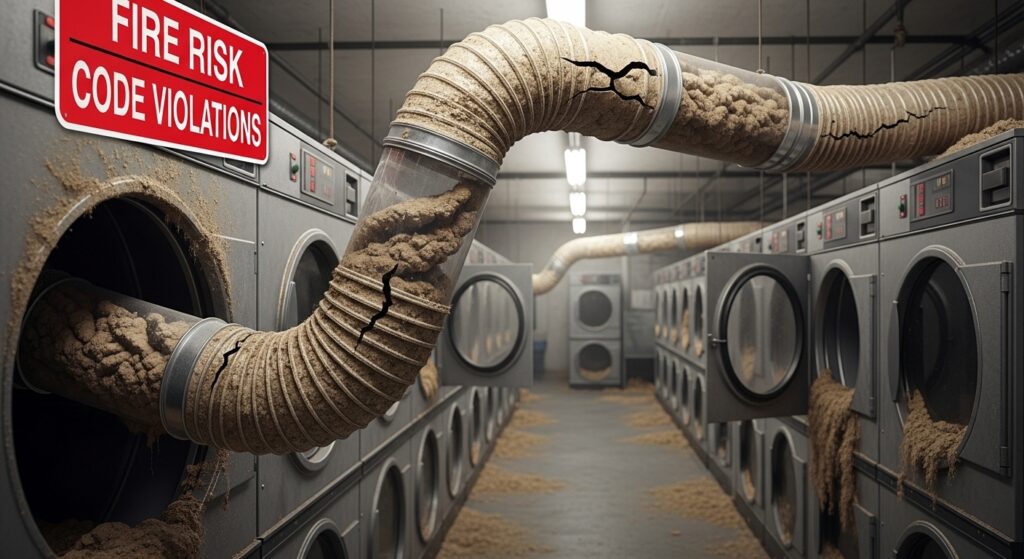
Commercial dryer vent fires build slowly, silently, and completely out of sight. That invisibility is exactly what makes them so dangerous in a facility where nobody monitors the ductwork between cycles.
Where Lint Actually Goes After the Trap
Most operators assume the lint trap captures everything a drying cycle produces. In reality, a significant portion bypasses it entirely and travels deeper into the ductwork with the exhaust airflow on every single load.
Where Lint Collects Inside Commercial Systems
- Inside elbows and bends where exhaust slows and debris settles
- Along horizontal duct runs that cannot self-clear by gravity
- At diameter transitions where airflow naturally restricts
- Around rooftop terminations where exhaust exits the building
- Inside shared flue systems serving multiple dryers across different floors
How a Commercial Dryer Fire Actually Starts
As lint accumulates, airflow inside the duct restricts progressively. The dryer compensates by running hotter and longer on every cycle. Internal duct temperatures climb steadily until heat reaches lint’s ignition point, and once ignition begins, fire travels the full length of the duct run before anyone in the facility detects smoke.
What Makes Commercial Systems Uniquely Dangerous
- Daily cycle volume accelerates buildup far beyond any residential rate
- Long commercial duct runs give fire more distance to travel before detection
- Shared exhaust flues concentrate buildup from multiple dryers into one critical pathway
- Seven-day continuous operation leaves no natural cooling interval between uses
Key Risks of Blocked Commercial Dryer Vents
- Carbon Monoxide Backup
Blocked vents can force combustion gases back into the facility. Carbon monoxide is odorless and undetectable without monitoring, making enclosed laundry areas especially vulnerable.
- Nest Blockages and Fire Risk
Bird or rodent nests inside vents restrict airflow and combine with lint buildup, creating fast ignition conditions that standard maintenance often misses.
- Equipment Overload and Damage
Restricted airflow forces dryers to run hotter and longer, increasing wear on motors and heating elements and leading to frequent, avoidable breakdowns.
Did You Know?
Dryer fires cause an estimated $238 million in property damage annually across the United States, according to the U.S. Fire Administration. Nearly every one of those fires is preventable, with lint buildup and failure to clean cited as the primary cause in the overwhelming majority of incidents.
Warning Signs Your Vents Are Already at Risk
Performance Warning Signs
- Loads need more than one full cycle to dry
- Dryer cabinets hot to the touch during normal operation
- Burning smell during or after dryer use
- Dryers shutting off mid-cycle due to thermal overload
- Laundry rooms unusually warm while dryers run
Physical Warning Signs
- Lint visible around the exterior vent termination
- Lint collecting on the floor behind dryer units
- Reduced airflow felt at the exterior vent opening
- Moisture or condensation on duct surfaces or walls
- Evidence of nesting at vent termination points
The Code Violations NJ Businesses Don’t Know They Have
Most commercial operators learned about Section 504 enforcement from a violation notice. Their maintenance provider never mentioned it, which means the violation was already in place long before anyone knew to address it.
What Section 504 of the IMC Actually Requires
New Jersey began active enforcement of the 2021 International Mechanical Code in October 2023. Section 504 governs every element of commercial dryer exhaust system design, installation, and maintenance. Fire prevention officers treat non-compliance as a life-safety issue rather than an administrative technicality.
Key Mandates Under Active NJ Enforcement
- Section 504.1: Dryers must exhaust per the manufacturer’s installation instructions
- Section 504.4: Ducts terminate outside the building with a backdraft damper, screens explicitly prohibited
- Section 504.4: Duct joints cannot use screws protruding into the duct interior
- Section 504.6: Duct length and configuration must meet specific commercial exhaust measurements
Three Violations Most NJ Facilities Already Have
Violation 1: Screened and Caged Vent Covers
Section 504.4 prohibits screens and caged covers on dryer vent terminations. Many facilities installed these years ago for pest prevention. Under current NJ enforcement, every one of those covers is an active violation, and some municipal fire prevention officers have extended this interpretation to include open plastic cages and wire mesh covers of any aperture size.
Violation 2: Screw-Fastened Duct Joints
Section 504.4 prohibits duct joints fastened with screws protruding into the duct interior. This was standard installation practice for years before the code changed. Protruding screws snag lint at every connection point, creating concentrated buildup exactly where ignition risk is highest. Most older commercial installations carry this violation without knowing it exists.
Violation 3: Duct Length Exceeding Commercial Specifications
Section 504.6 specifies maximum duct lengths for commercial exhaust systems. Many commercial buildings with dryers installed far from exterior walls exceed these limits. Running an extended duct without a properly specified exhaust fan supporting the system is a direct violation of current NJ code.
Did You Know?
A single commercial dryer running eight hours daily produces roughly four times more lint than a residential unit running the same duration.
Common Code Violations Found Across NJ Commercial Facilities
- Screened or caged vent covers installed before October 2023 enforcement
- Screw-fastened duct joints protruding into the duct interior
- Duct runs exceeding permitted length without proper exhaust fan support
- Flexible plastic or foil accordion hose used as primary duct material
- Duct systems not terminating directly to the building exterior
- Missing or non-functional backdraft dampers at termination points
Alpha Clean Air’s NADCA-certified technicians identify every active Section 504 violation during inspection and document findings for your compliance records. Every service includes a signed cleaning certification built specifically to satisfy NJ fire marshal requirements.
Why NJ Businesses Cannot Afford to Ignore This
The fire risk is real and the code is actively enforced. Here is the complete financial and operational picture of what ignoring both actually costs a New Jersey business.
The Financial Consequences Stack Quickly
A violation notice triggers a chain of consequences that do not stay isolated from each other. Each non-compliant element identified during a fire marshal inspection carries its own penalty. Those penalties compound alongside the underlying liability exposure the business already faces.
What Non-Compliance Actually Costs
- Fines: Monetary penalties issued per non-compliant element found
- Legal liability: A fire traced to a violation opens the business to civil litigation
- Insurance exclusions: Many policies exclude damage caused by known code violations
- Forced closure: Facilities failing inspection can be ordered to stop operations immediately
- No documentation defense: Without cleaning records, there is no proof of due diligence
The Insurance Gap Most Operators Discover Too Late
Many commercial property policies explicitly exclude fire damage caused by code violations the insured knew about or reasonably should have known about. A fire marshal inspection that finds violations on record, followed by a fire traced to those same conditions, creates a documentation gap insurer use to deny claims. Signed cleaning certifications from a NADCA-certified provider close to that gap before any incident occurs. That protection is something no competitor in this market consistently explains to NJ facility managers, and it is often the difference between a denied claim and a fully covered loss.
Which NJ Facilities Face the Greatest Exposure
Laundromats
Running more daily dryer cycles than any other commercial category, lint in a busy laundromat can reach dangerous levels in as little as three months. Professional cleaning every three to six months is the minimum safe interval for these facilities.
Hotels and Hospitality Properties
Continuous overnight laundry operations generate significant lint per cycle from linen, towels, and bedding. A fire in a hotel laundry room simultaneously threatens guests, staff, and the entire property.
Apartment Complexes and Multi-Unit Buildings
In shared exhaust flue systems, a blockage or ignition in the common vertical duct affects every resident at once. Fire can spread through the building structure before any individual unit alarm activates.
Healthcare and Senior Living Facilities
High cycle volume combined with a vulnerable resident population makes fire prevention a life-safety obligation. Any operational disruption carries consequences far beyond property damage alone.
Gyms and Athletic Facilities
Towels are among the heaviest lint producers due to their loop fiber construction. Facilities offering towel service consistently underestimate how quickly commercial vents require professional attention as a result.
How Often NJ Businesses Should Schedule Cleaning
| Facility Type | Recommended Frequency |
| Heavy-use laundromats | Every 3 to 6 months |
| Hotels and hospitality | Every 3 to 6 months |
| Apartment complexes | Every 6 to 12 months |
| Healthcare and senior living | Every 3 to 6 months |
| Gyms with towel service | Every 6 months |
| Light commercial use | Annually at minimum |
What Alpha Clean Air’s Commercial Service Covers
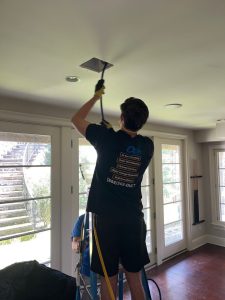
Most competitors clean only the accessible sections of a duct run. Alpha Clean Air’s commercial dryer vent service covers the full system from dryer connection to exterior termination. Camera scoping identifies what standard cleaning equipment cannot reach, closing the gaps that partial cleaning leaves behind.
- Protective setup: Barriers placed around dryers to contain lint during cleaning
- Vent cover removal: Outer covers removed for complete duct access
- Mechanical brushing: All pipes, bends, and transitions thoroughly brushed
- Vacuum extraction: Industrial hoses clear packed lint along the full duct path
- Camera scoping: Identifies disconnected pipes, nests, and hidden blockages
- Reassembly and inspection: Components reassembled with a final compliance check
- Signed certification: Certificate issued for fire marshal and insurance records
Final Thoughts
Lint builds silently. Heat climbs gradually. Failure happens without warning, and by the time a burning smell or thermal shutdown signals a problem, the system is already in a dangerous state.
New Jersey’s active enforcement of IMC Section 504 means the compliance question is no longer theoretical. Fire marshals are issuing violations, businesses without cleaning documentation are exposed, and facilities with prohibited vent covers are receiving notices requiring immediate correction.
Alpha Clean Air is New Jersey’s NADCA-certified commercial dryer vent cleaning specialist, serving laundromats, hotels, apartment complexes, and facilities across the Tri-State area. Every service includes full inspection, professional cleaning, and signed certifications built to satisfy fire marshal requirements.
FAQs
Is commercial dryer vent cleaning legally required in New Jersey?
Yes. New Jersey enforces Section 504 of the 2021 International Mechanical Code, active since October 2023. Fire prevention officers are issuing violations for prohibited screens, screw-fastened duct joints, and improper vent terminations across the state.
How often does a commercial dryer vent need professional cleaning in NJ?
Heavy-use facilities like laundromats, hotels, and healthcare laundry rooms need cleaning every three to six months. Lower-volume operations should schedule at least annually, with frequency increasing whenever performance warning signs appear before the next scheduled service.
Can a clogged dryer vent cause carbon monoxide exposure in a commercial facility?
Yes. When a gas dryer cannot exhaust through a blocked vent, combustion gases including carbon monoxide back up into the facility. Enclosed laundry rooms with limited ventilation carry the highest risk because symptoms only appear after exposure has already occurred.
What documentation does a NJ business need after professional cleaning?
Every professional cleaning should produce a signed certificate documenting the date, technician, and scope of work completed. This record proves due diligence during fire marshal inspections and protects the business if an insurance claim is ever filed.